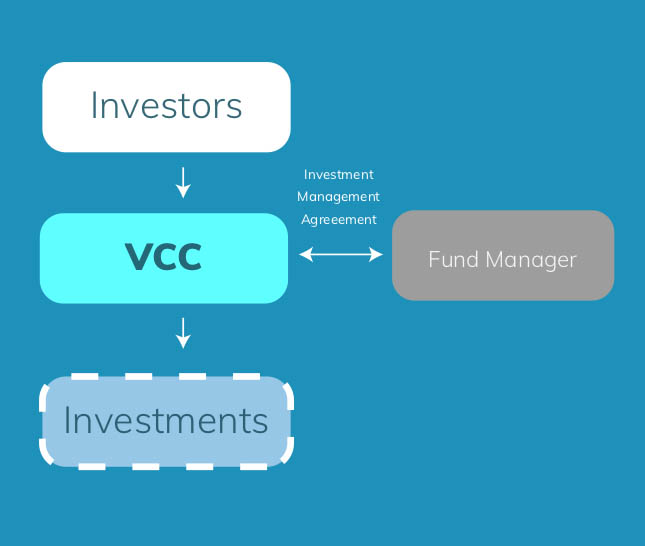
It is a new legal entity form/structure for investment funds administered by ACRA with AML obligations of VCC under MAS guidelines
What can it be used for ?
Traditional and alternative
fund strategies (both open-ended and close-ended)
How can it be set up ?
As a stand-alone or as an umbrella entity with multiple sub-funds
Can a foreign fund be re-domiciled ?
Foreign corporate entities can
re-domiciled to Singapore as VCCs
What do you need ?
Local registered filing agent Corporate secretary
Singapore based fund administrator
( If 13R or 13X application is considered )
VCC must be managed by Fund Manager regulated by MAS
What are the benefits?
Enhanced safeguard by segregation of assets and liabilities in each sub-fund
Financial statements are not required to be made public
VCC registar members private but need to be provided upon request to certain persons such as public authorities, VCC manager and custodian
Improved operational and tax efficiency
Greater flexibility in issuance and redeeming shares, payment of dividends out of capital
Requirements of a VCC?
The capital of a VCC will always be equal to its net assets, thereby providing flexibility in the distribution and reduction of capital
All VCC must be managed by a Permissable Fund Manager. It will require a Singapore-based licensed or regulated fund manager (unless exempted under the regulation*)
Existing Securities and Futures Act (SFA) requirements for investment funds will apply to VCCs
It must have at least one Singapore resident director and at least one director (may be the same as resident director) who is either a director or qualified rep of the VCC fund manager. For non-autorised scheme and at least 3 directors for authorised scheme
A VCC must have its registered office in Singapore and must appoint a Singapore-based company secretary. A VCC must have at least one shareholder
It must be subject to audit by a Singapore-based auditor and must present its financial statements as per IFRS, Singapore FRS, US GAAP, or RAP 7
* Currently, fund managers exempt from regulations – real estate, single family offices, and related party exemption – cannot use VCC.
This list may be intended to expand in future.
VCC – Fund Structure and Tax Treatment
Stand-alone (Single fund) VCC
VCCs may be set up as a single fund VCC (commonly referred to a Standalone VCC).
The tax treatment of a stand-alone VCC will remain the same as that of a Singapore company
The Enhanced Tier Fund (”ETF”) Scheme(13X) and Singapore Resident Fund (”SRF’)(13R) Scheme under the Income Tax Act will apply to a stand-alone VCC similar to a Singapore company as accordingly
Umbrella (Multiple Sub Fund) VCC
The VCC can also be set up with multiple Sub Funds ( Commonly referred to as an Umbrella VCC )
Summary of key features and conditions of tax incentives schemes in Singapore for funds
Other Tax Related Key Elements
GST
The current GST remission will be made available to VCCs approved under the ETF and SRF schemes.
Certificate of Residence (“COR”)
A Singapore COR is available for the VCC subject to the VCC establishing that it is controlled and managed from Singapore.
In the case of an umbrella VCC, the COR will be issued on the VCC master umbrella level, with the names of the sub-funds receiving the same nature of income from the same treaty country included in the COR
Withholding tax exemption
The current withholding tax exemption available to funds approved under the ETF and SRF schemes will be available to VCCs approved under the ETF and SRF schemes.
Incentive scheme for fund managers
The 10% concessionary tax rate under the Financial Sector Incentive – Fund Management Scheme will be extended to approved fund managers managing incentivised VCCs.
Investment Objective Condition
One of the current conditions of the ETF and SRF scheme is that once the funds has been approved under either schemes, the funds will not be permitted to change unless permitted or approved by authorities. This is applicable to all sub funds.
Addition of new sub funds
There is no need to seek approval from or inform the authorities if there are new sub-funds added to a VCC. However, where the investment scope has changed with the addition of a new sub-fund, an approval will be needed from the authorities to expand the investment scope. Further, if there is an announcement of termination of the ETF and SRF schemes, then additions of sub-funds will not be allowed.
For more information or a PDF Version of this post feel free to drop me a note on linkedin.
Thank you for attending and meeting our team John Hebert Chris Daly Liam McHugh at the Sparkplus event in Singapore this evening. We had a great night and great conversations. A big appreciation to the efforts of the organiser and our joint sponsors for the event.
VCC Launched 15 Jan 2020:
Singapore launches new fund framework as Game Changer to boost Asset Management Industry
The Launch
The Monetary Authority of Singapore (MAS) and the Accounting and Corporate Regulatory Authority (ACRA) launched the Variable Capital Companies (VCC) framework on 15th Jan 2020. The VCC is a new corporate structure launched used for a wide range of investment funds and provides fund managers greater operational flexibility and cost savings.
Fund managers will be able to constitute investment funds as VCCs across both traditional and alternative strategies, and as open-ended or closed-end funds for new fund launches or conversion from existing fund structures. Fund managers may also incorporate new VCCs or re-domicile their existing investment funds with comparable structures by transferring their registration to Singapore as VCCs. A VCC must appoint a fund manager that is regulated by MAS to manage its investments. For further details on the eligibility of fund managers to manage a VCC, please refer to the Explanatory Brief on the Variable Capital Companies Bill on 10 September 2018, available on the MAS website.
ACRA – Variable Capital Companies Act
14th January also marked the launch of ACRA’s online application platform, for more information, please refer to https://www.acra.gov.sg/business-entities/variable-capital-companies.
The Variable Capital Company (VCC) is constituted under the Variable Capital Companies Act which took effect on 14 Jan 2020. The VCC is aimed to complement the existing suite of investment fund structures available in Singapore.
The VCC Act and subsidiary legislation is administered by ACRA. All VCCs must be managed by a Permissible Fund Manager [1]. The anti-money laundering and countering the financing of terrorism obligations of VCCs will come under the purview of the Monetary Authority of Singapore (MAS).
Some Key Features of VCC as a Corporate Structure:
● A VCC has a variable capital structure that provides flexibility in the issuance and redemption of its shares. It can also pay dividends out of capital, which gives fund managers flexibility to meet dividend payment obligations.
● A VCC can be set up as a single standalone fund or an umbrella fund with two or more sub-funds, each holding a portfolio of segregated assets and liabilities. For fund managers that structure their funds as umbrella VCCs, theremay be cost efficiencies from using common service providers across the umbrella and its sub-funds.
● A VCC can be used for both open-ended and closed-end fund strategies [2] .
● Fund managers may incorporate new VCCs or re-domicile their existing overseas investment funds with comparable structures by transferring their registration to Singapore as VCCs.
● VCCs must maintain a register of shareholders, which need not be made public. However, this register must be disclosed to public authorities upon request for regulatory, supervisory and law enforcement purposes.
[1] Generally, a VCC will have to be managed by a fund manager which is a licensed fund management company (i.e. a holder of a capital markets services licence for fund management under section 86 of the Securities and Futures Act (Cap. 289)), a registered fund management company (i.e. a corporation exempted from holding a capital markets services licence under paragraph 5(1)(i) of the Second Schedule to the Securities and Futures (Licensing and Conduct of Business) Regulations) or a person exempted under the Section 99(1)(a), (b), (c), or (d) of the Securities and Futures Act (Cap. 289) from the requirement to hold a capital markets services licence to carry on business in fund management (i.e. a bank licensed under the Banking Act (Cap. 19), a merchant bank approved under the Monetary Authority of Singapore Act (Cap. 186), a finance company licensed under the Finance Companies Act (Cap. 108), or a company or cooperative society licensed under the Insurance Act (Cap. 142)).
[2] An open-ended fund allows investors to redeem their investments at their discretion, while a closed-end fund does not permit investors to do so. Closed-end funds also have a fixed number of shares and do not allow new subscriptions after the offering period is over, while open-ended funds are open to new subscriptions by new investors at any time.
Pilot and Grants
A total of 18 fund managers participated in a VCC Pilot Programme that was initiated by MAS and ACRA in September last year. All of these fund managers have today incorporated or re-domiciled a total of 20 investment funds as VCCs. These investment funds comprised of venture capital, private equity, hedge fund and Environmental, Social, and Governance (ESG) strategies, demonstrating the viability of the VCC framework across diverse use cases. The list of fund managers that participated in the VCC Pilot Programme is set out in the Annex on MAS’ website.
MAS launches new VCC grant scheme for fund managers
THE Monetary Authority of Singapore (MAS) on Wednesday launched a new variable capital companies (VCC) grant scheme to help fund managers with costs when incorporating or registering a VCC.
MAS will co-fund up to 70 per cent of eligible expenses paid to Singapore-based service providers. The grant is capped at S$150,000 for each application, with a maximum of three VCCs per fund manager.
The new grant scheme will be available for up to three years, funded by the Financial Sector Development Fund established by MAS in 1999 which looks to encourage industry adoption of the freshly launched VCC framework in Singapore.
Corporate structure incorporated under the VCC Act
Administered by the Accounting and Corporate Regulatory Authority (ACRA)
Managed by a fund manager regulated by the Monetary Authority of Singapore (MAS)
Ability to consist variable capital structure:
Flexibility in the issuance and redemption of shares
Dividends payments out of capital – Fund managers flexibility to meet dividend payment obligations
As Single standalone fund or an Umbrella fund with sub-funds
Cost efficiencies from using common service providers across the umbrella and its sub-funds
Can be used for both open-ended and closed-end fund strategies
VCC Requirements and Highlights
“The Game-Changer for Singapore’s Fund Management Industry”
Singapore Based Requirements
Singapore-based licenced or regulated fund manager (unless exempted under regulations)
Registered Office in Singapore, Singapore based company secretary
Subjected to audit by Singapore-based auditor
Singapore Based Fund Administrator (Required if considering for tax incentives schemes such as 13R/13X)
Directors Requirement
Non-Authorised Schemes
– At least 1 Singapore Resident Director
Authorised Schemes
– At least 3 Directors
* An
Authorised scheme are schemes such as the CIS that is constituted in Singapore
and authorised by MAS or any schemes as defined by MAS
*There are currently out of scope scenarios for the VCC adoption, such as fund managers exempted from regulations (such as non-regulated real estate managers or have already been granted incentive schemes on exemptions)
*At least One Director of the VCC must be a Director of the Fund Manager or must be a Qualified Representative
* Directors of VCCs must be fit and proper based on the guidelines provided in the regulations. Some areas to be looked at include the Director’s past conduct, application history as a director of financial institution, similar VCC entities, adverse information on due-diligence, compliance and AML perspective for the assessment consideration.
Foreign Fund Re-domiciliation
Foreign Corporate Entities (Fund
Structured) could be re-domiciled as VCCs
Please
observe MAS’s proposal on requirements for assessment.
Capital and Members reflection/ requirement
Capital of a VCC is suggested to
be equal to its net assets, providing flexibility in the distribution and
reduction of capital
VCC should have at least
one member (to align with the minimum number of members for companies under the
Companies Act)
Allowance for Master-Feeder
Fund Structures: – VCCs can have a single shareholder or hold a single asset
Accounting Standards
Option of Presentation of Financial Statements per IFRS, Singapore FRS or US GAAP and Financial Statements of VCC consisting of authorised scheme to use RAP7
Tax
Umbrella VCC only need to
file single Corporate Income Tax (CIT) return with the Inland Revenue Authority
of Singapore (IRAS), regardless of the number of sub-funds the umbrella VCC has
Tax incentives under
sections 13R and 13X of the Income Tax Act will be extended to VCCs when
qualifying conditions are fulfilled
For umbrella VCCs, these tax incentives will be granted at the umbrella level
Should you
consider VCC?
Singapore
has positioned herself as a developed asset management centre with a conducive
environment for asset managers and asset owners to locate and hub their
investment activities.
With the
trend of onshoring and consolidation in views for establishing economic
substance, onshoring in Singapore on the fund manager level; incorporating the VCC in the fund structure allows the funds to
benefit from the extensive number of DTAs signed with Singapore as a jurisdiction
as well as tax incentives under the available schemes.
Given its flexibility on capital structure, suitable to be tailormade to different investment strategies, the VCC will provide an alternative even for Fund structures onshoring to Singapore or already onshore in Singapore.