
Setting up Singapore Family Office

A family office is an organization created to manage the wealth and investments of a high net worth family or individual. It provides a range of services such as investment management, tax planning, philanthropy, and estate planning. Singapore is an attractive location to set up a family office due to its stable economy, favorable tax policies, and business-friendly environment.


The following is a step-by-step guide to setting up a family office in Singapore:

Step 1 : Define your objectives

Before setting up a family office, it is important to determine the objectives of the office. This includes identifying the family’s current and future financial needs, goals, and priorities. This will help in determining the type of services required from the family office.


Step 2: Choose the right structure

The next step is to choose the right structure for the family office. The most common structures are a single-family office, which is created for a single family, or a multi-family office, which serves multiple families. Other options include a private trust company or a corporate entity. Each structure has its own advantages and disadvantages, so it is important to choose the one that best fits the family’s objectives.


Step 3: Determine the regulatory requirements

Family offices in Singapore are regulated by the Monetary Authority of Singapore (MAS). The regulatory requirements will vary depending on the structure of the family office. For example, a single-family office may not be required to be licensed by the MAS, while a multi-family office will require a capital market services license. It is important to seek professional advice to ensure compliance with the regulatory requirements.


Step 4: Choose the right service providers

Once the structure has been determined and regulatory requirements have been met, the family office will require the services of various professionals such as lawyers, administrators, accountants, and investment managers. It is important to choose service providers who are experienced in working with family offices and have a good understanding of the family’s objectives.


Step 5: Implement the family office

Once all the steps above have been completed, the family office can be implemented. This include establishing policies and procedures, hiring staff, and setting up systems for investment management, accounting, and reporting. It is important to ensure that the family office is structured in a way that is flexible and can adapt to changing circumstances.

In conclusion, setting up a family office in Singapore can be a complex process, but with proper planning and guidance, it can be accomplished efficiently. It is important to define the family’s objectives, choose the right structure, determine the regulatory requirements, choose the right service providers, and implement the family office. Seeking professional advice is essential to ensure compliance with regulatory requirements and the successful implementation of the family office.





agneslinkedingold copy


The Singapore Variable Capital Company


What is VCC?


It is a new legal entity form/structure for investment funds administered by ACRA with AML obligations of VCC under MAS guidelines


What can it be used for ?


Traditional and alternative fund strategies (both open-ended and close-ended)


How can it be set up ?


As a stand-alone or as an umbrella entity with multiple sub-funds


Can a foreign fund be re-domiciled ?


Foreign corporate entities can re-domiciled to Singapore as VCCs


What do you need ?


  • Local registered filing agent Corporate secretary

  • Singapore based fund administrator ( If 13R or 13X application is considered )

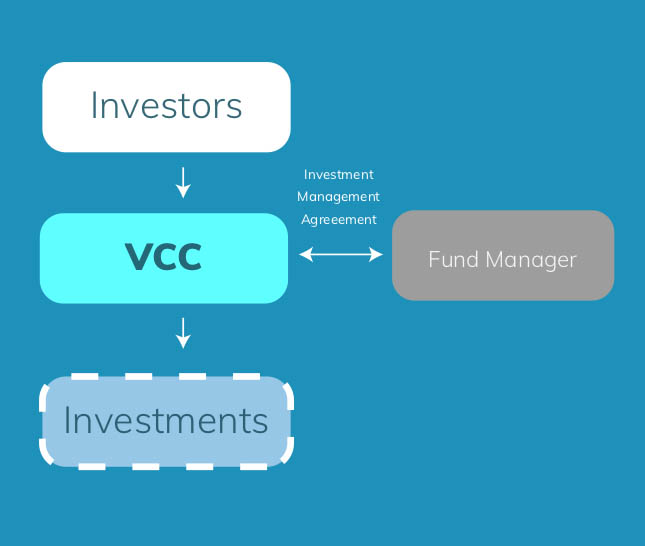
  • VCC must be managed by Fund Manager regulated by MAS


What are the benefits?


  • Enhanced safeguard by segregation of assets and liabilities in each sub-fund

  • Financial statements are not required to be made public

  • VCC registar members private but need to be provided upon request to certain persons such as public authorities, VCC manager and custodian

  • Improved operational and tax efficiency

  • Greater flexibility in issuance and redeeming shares, payment of dividends out of capital


Requirements of a VCC?


  • The capital of a VCC will always be equal to its net assets, thereby providing flexibility in the distribution and reduction of capital

  • All VCC must be managed by a Permissable Fund Manager. It will require a Singapore-based licensed or regulated fund manager (unless exempted under the regulation*)

  • Existing Securities and Futures Act (SFA) requirements for investment funds will apply to VCCs

  • It must have at least one Singapore resident director and at least one director (may be the same as resident director) who is either a director or qualified rep of the VCC fund manager. For non-autorised scheme and at least 3 directors for authorised scheme

  • A VCC must have its registered office in Singapore and must appoint a Singapore-based company secretary. A VCC must have at least one shareholder

  • It must be subject to audit by a Singapore-based auditor and must present its financial statements as per IFRS, Singapore FRS, US GAAP, or RAP 7


  • * Currently, fund managers exempt from regulations – real estate, single family offices, and related party exemption – cannot use VCC. This list may be intended to expand in future.


VCC – Fund Structure and Tax Treatment

Stand-alone (Single fund) VCC


VCCs may be set up as a single fund VCC (commonly referred to a Standalone VCC).

The tax treatment of a stand-alone VCC will remain the same as that of a Singapore company

The Enhanced Tier Fund (”ETF”) Scheme(13X) and Singapore Resident Fund (”SRF’)(13R) Scheme under the Income Tax Act will apply to a stand-alone VCC similar to a Singapore company as accordingly


Umbrella (Multiple Sub Fund) VCC


The VCC can also be set up with multiple Sub Funds
( Commonly referred to as an Umbrella VCC )


Summary of key features and conditions of tax incentives schemes in Singapore for funds


Other Tax Related Key Elements

GST


The current GST remission will be made available to VCCs approved under the ETF and SRF schemes.


Certificate of Residence (“COR”)


A Singapore COR is available for the VCC subject to the VCC establishing that it is controlled and managed from Singapore.

In the case of an umbrella VCC, the COR will be issued on the VCC master umbrella level, with the names of the sub-funds receiving the same nature of income from the same treaty country included in the COR


Withholding tax exemption


The current withholding tax exemption available to funds approved under the ETF and SRF schemes will be available to VCCs approved under the ETF and SRF schemes.


Incentive scheme for fund managers


The 10% concessionary tax rate under the Financial Sector Incentive – Fund Management Scheme will be extended to approved fund managers managing incentivised VCCs.


Investment Objective Condition


One of the current conditions of the ETF and SRF scheme is that once the funds has been approved under either schemes, the funds will not be permitted to change unless permitted or approved by authorities. This is applicable to all sub funds.


Addition of new sub funds


There is no need to seek approval from or inform the authorities if there are new sub-funds added to a VCC. However, where the investment scope has changed with the addition of a new sub-fund, an approval will be needed from the authorities to expand the investment scope. Further, if there is an announcement of termination of the ETF and SRF schemes, then additions of sub-funds will not be allowed.


For more information or a PDF Version of this post feel free to drop me a note on linkedin.

agneslinkedingold copy


Declaration of Trust

A declaration of trust is

  • Usually a legal document

  • Indicating a property/ asset is being held for the benefit of another person or individuals

  • The trustee receives the asset and arranges the property as well as designated assets such as cash and securities into a trust

  • An appointed trustee such as an individual or financial institution administers this trust in the best interests of beneficiaries as explained in the declaration of trust


A declaration of trust outlines:

  • Who the trust is in benefit of

  • Who can amend or revoke the trust (if it can be amended at all)

  • Who will serve as trustee and what powers the trustee holds

  • The statement also includes information regarding what is to happen if a beneficiary wants to receive distributions.

  • It may also highlight details about the types of assets within a trust.

The declaration also presents the trust’s purpose or objectives and how the trustee may invest and manage assets to support beneficiaries. It also may explain who will replace the trustee in the event of illness, incapacitation, death or any other reason such as resulting legal action taken against the trustee.


For more information.

agneslinkedingold copy


Foreign Grantor Trust

A FGT is used to describe a trust established by a Grantor, a non United States (“US”) person to benefit US beneficiaries. For US Federal tax purposes, the Grantor will still be regarded as the owner of the FGT’s assets in his/her lifetime. The Grantor would normally be exempted from US tax on non- US assets, income or gains.

US Transfer Tax Planning

US Estate and Gift taxes are among the highest in the world, and it is applicable to the worldwide assets of a US Person regardless of their residency status. Despite holding a passport from, or being a citizen of, another country, a US Person, Green Card holder or US tax resident individual is not exempted from their worldwide US tax and reporting obligations. A trust that does not qualify as a FGT might subject US family members to adverse tax rates with an additional compounding interest charge on any undistributed income and gains in the year realized. This could result in current tax and/or reporting obligations for the US family members with respect to any Passive Foreign Investment Companies or Controlled Foreign Corporations assets held by the trust. Furthermore, assets transferred to US family members are taxable on future income and gains, and are generally reportable to the US IRS. Grantors should seek US tax advice when creating a FGT. The advice should take into account the restructuring of the trust upon the Grantor’s demise. This includes taking into consideration the size of the trust assets, trust fund distributions and the needs of the US family members at the time of the Grantor’s passing, so as to achieve desirable tax benefits.

US law treats the United States persons and foreign persons differently for tax purposes. Foreign Grantor Trust (FGT) is a trust established by a foreign person who intends to benefit the US beneficiaries. The trust is revocable and is structured in a manner which treats the non-US grantor as the tax owner of the trust assets for US purposes, no US income tax on non-US source income of the trust are involved.

For more information.

agneslinkedingold copy


Employee Benefit Trust

To attract and retain key executives in the company, employer can use company shares / options as incentives to encourage loyalty and commitment of core members, which commonly known as ‘Employee Benefit Scheme’. An Employee Benefit Trust (EBT) can be setup anytime (usually recommended established before listing or funding event) in holding shares / share options of the company. When the granted awards (i.e. the shares / share options) are vested, relevant employees would be entitled to receive the awards, exercise it and could receive cash after exercise.

Establishment

In an EBT structure, the Executive is the settlor and/or beneficiary under the trust. While employees can be included in the scheme as beneficiaries. The establishment of the EBT is a simple and straightforward process, which normally entails the Trustee and the Executive executing a customised trust instrument. Formation can typically be completed in a short period of time.

For more information.

agneslinkedingold copy


Pre-IPO Planning

Are you planning an IPO?

With the backdrop of a strong Asian economy driving IPO activities, the focus of business owners planning for an IPO tends to be on the advantages that a successful listing can bring to the company. The importance of personal wealth planning is often neglected.

Whether the aim of an IPO is to raise capital or as an exit strategy, proper wealth planning done in advance of an IPO can bring many benefits, such as minimization of asset valuation issues, asset protection, avoidance of probate, and ease of transfer of assets. While commonly employed wealth planning vehicles such as an investment company have proven to be effective, as an alternative, a properly structured private trust offers a number of features that distinguishes it from the others.

“A Trust is a relationship in which the Trustee holds legal title to assets for the benefit of the Beneficiaries.”

A Pre-IPO Trust generally refers to a trust structure that is established to hold shares of private companies before listing.


For more information.

agneslinkedingold copy