Hong Kong or Singapore?

Has Singapore become a victim of its own success? And can Hong Kong recover its position?

Hong Kong (left) or Singapore (right)?

As the most prominent financial hubs in Asia, and increasingly in the world, Hong Kong and Singapore have been pitted against each other time after time. The competition between the two cities is infamous, but is it time to lay down the swords? Citywealth speaks to industry experts on how the cities can complement, rather than compete against, one another. We dive into the strengths and weaknesses of each city, as highlighted by those who deal with them firsthand, and uncover all the necessary considerations for UHNW individuals and their advisers when choosing which city is best suited to their unique circumstances.

Despite the rapid growth of Hong Kong and Singapore as dominant players in the race to become leading hubs for family offices, there are current concerns surrounding each city. Two key questions come to mind: Are people leaving Hong Kong, and why? Has Singapore become a victim of its own success as its cost-of-living rises?

Regarding Hong Kong, Partner at Zhong Lun Clifford Ng said: “There is empirical evidence that people have been leaving Hong Kong. If nothing else, the delay in reopening compared with other financial centres including Singapore was a major catalyst. However, the tide has probably changed, and I expect there will be net inflows to Hong Kong through the remainder of the year.”

Of Singapore, he added: “Singapore has been extremely successful in attracting people through their family office regime and because Singapore reopened much sooner than Hong Kong. That has reflected in much higher housing costs.  For small cities like Singapore and Hong Kong, it doesn’t take a lot to move housing prices.”

Agnes Chen, Managing Director APAC for CSC Global Financial Markets, a trust company, commented on Hong Kong: “We believe that there are reports made of individuals and businesses relocating or making adjustments to their presence in Hong Kong. During the Covid situation people did this to be nearer to their direct families. Some of this may be influenced by factors such as policies. Decisions to move are often a mix of numerous factors but we have seen stability since the reopening of Hong Kong from Covid times to bring back more visitors and travelers.”

In response to the question on Singapore’s rising cost of living, Chen said: “Singapore is known in global indexes as one of the most expensive cities in the world and for its high cost of living compared to many other countries. The perception of affordability can vary depending on individual circumstances, perspectives, or lifestyles. While Singapore does have to a certain extent a relatively high cost of living, it also offers a high standard of living with excellent infrastructure, healthcare, safety, wellness and education.”

“Singapore’s strength is also her proactive and engaging policy makers and has implemented quick and immediate measures to mitigate challenges and ensure balance between economic growth and social wellbeing as needed. I would say the interpretation is subjective to the individual based on the balance preferred.”

Hong Kong is an integral part of China. Singapore is not.

Whilst they share the continent of Asia, the geographical placement of each city is a crucial consideration. Ng said: “The key difference between the two is that Hong Kong is an integral part of China and Singapore is not. For clients who want to have some money and infrastructure outside China, Singapore is the logical choice. For those who want some money and infrastructure inside China, Hong Kong is the place. Those based in Hong Kong do not need to give up their China status which is key to hold certain businesses in China. Many UHNW clients will see a need to be in both places, so I see them as complementary and not competitive.”

The Monetary Authority of Singapore is actively promoting Singapore as a hub for family offices

Chen weighed up the two cities in terms of their regulatory environments, and how their respective locations and resulting target markets overlap. She said: “One of Singapore’s strengths is its regulatory environment, which is known for being business-friendly and transparent. Their financial regulator, Monetary Authority of Singapore (MAS), has been actively promoting Singapore as a hub for family offices and has introduced various initiatives to attract wealth managers, such as the Variable Capital Company (VCC) framework. The VCC framework allows family offices to set up investment funds in Singapore. Hong Kong, on the other hand, has long been a gateway to China and is well-positioned to serve the country’s growing number of high-net-worth individuals. Hong Kong is also known for its deep and liquid capital markets, which provide a wide range of investment opportunities for family offices.”

“Both cites target different markets, with Singapore focusing on Southeast Asia and Hong Kong on Greater China. Singapore has a strong presence in Southeast Asia and has been attracting family offices from countries such as Indonesia, Malaysia, and Thailand and some from the greater China region in the looks of expansion. In contrast, Hong Kong is a financial hub in Greater China and has been attracting family offices from mainland China, and other parts of East Asia. The Hong Kong Government had recently rolled out policies on developing family office businesses in Hong Kong, many of the initiatives such as capital investment entrant scheme, tax concessions, developing Hong Kong into a philanthropic centre, expanding the expertise in family offices, and launching a new network of family office service providers may also strengthen the city’s positioning as a financial hub.”

Hong Kong has a vibrant capital market and Singapore a larger forex business

Kevin LeeSuzanne Johnston, and Ross Davidson at Stephenson Harwood emphasised that the two cities play complementary roles, each offering unique benefits to families depending on their specific objectives. They said: “Singapore is better connected to the Southeast Asian market and India whilst Hong Kong offers proximity to the significant Chinese market with most of North Asia lying within a four-hour flight from Hong Kong. Private wealth management is growing in both markets with Hong Kong having a more vibrant capital market and Singapore having a larger forex business. Both markets have family office and immigration schemes to attract wealthy families.”

Tax benefits for family offices in Singapore

Stephenson Harwood continued: “Singapore has been at the forefront of the family office industry in recent years, offering two key incentive schemes – Sections 13O and 13U – that provide significant tax benefits for family offices in Singapore. Singapore therefore has early mover advantage in relation to its family office regime with its already well-established family office ecosystem. Hong Kong has recently introduced its own tax concessions for family-owned investment vehicles providing a similar tax regime to Singapore’s Sections 13O and 13U. While the Hong Kong regime is relatively new, it has already been met with enthusiasm.”

“In addition to the tax incentives, Singapore has a Global Investor Programme (GIP), which has been key in attracting family offices to Singapore. Principals can apply under the GIP for permanent residency provided they have a substantial business track record and at least S$200m in net investible AUM. Meanwhile, Hong Kong is planning to relaunch a modified version of its Capital Investment Entrant Scheme (CIES) as part of its efforts to attract more family offices and high-net-worth individuals to establish businesses and reside in Hong Kong. While real property would be excluded, investible assets under the CIES will potentially include innovation and technology sectors aside from financial assets. The CIES is expected to allow eligible applicants to obtain Hong Kong permanent residency status more easily and faster than under existing immigration schemes.”

Complementary? Or competition?

Stephenson Harwood concluded: “By understanding the strengths of each jurisdiction, families can identify the most suitable location for their specific needs and objectives.  As ever, there is no one size fits all approach.”

Ng agrees, saying “the two jurisdictions are fundamentally different in key aspects, and they are more complementary than competitors” and Chen concluded: “Both cities have their unique strengths and advantages, and family offices may choose one over the other based on factors such as regulatory environment, investment opportunities, tax policies, and cultural affinity. Ultimately, it’s up to individual family offices to determine which city is the best fit for their long-term objectives for their family.”

So, has Singapore become a victim of its own success? The answer is yes and no; it has certainly benefited from Hong Kong lockdowns, but it remains fast and furious with competitiveness and has a very different culture to Hong Kong due to its geography. Hong Kong is already showing signs of recovery with the outflows of people starting to slow and will always feast on the enormous inflows from mainland China. So, as our advisors determine – are they actually more complementary than competitors? Different opportunities are solidifying in both jurisdictions making them more of an Asian superpower, not too dissimilar to the comparisons of London.

Article by Ashleigh John

www.citywealthmag.com

The Singapore Variable Capital Company


What is VCC?


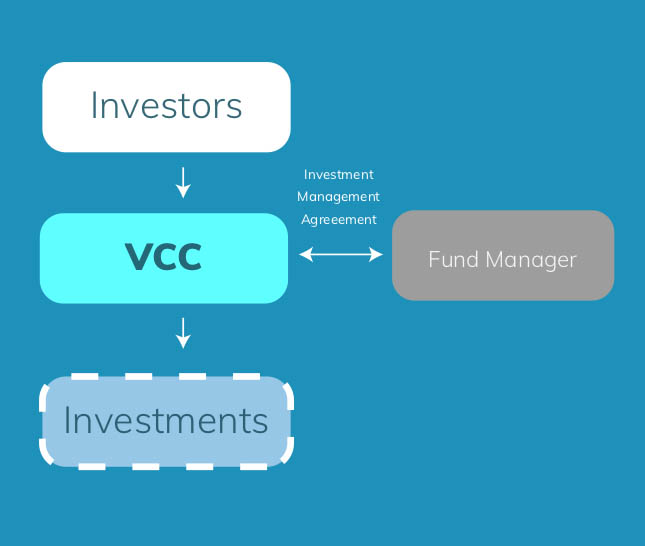
It is a new legal entity form/structure for investment funds administered by ACRA with AML obligations of VCC under MAS guidelines


What can it be used for ?


Traditional and alternative fund strategies (both open-ended and close-ended)


How can it be set up ?


As a stand-alone or as an umbrella entity with multiple sub-funds


Can a foreign fund be re-domiciled ?


Foreign corporate entities can re-domiciled to Singapore as VCCs


What do you need ?


  • Local registered filing agent Corporate secretary

  • Singapore based fund administrator ( If 13R or 13X application is considered )

  • VCC must be managed by Fund Manager regulated by MAS


What are the benefits?


  • Enhanced safeguard by segregation of assets and liabilities in each sub-fund

  • Financial statements are not required to be made public

  • VCC registar members private but need to be provided upon request to certain persons such as public authorities, VCC manager and custodian

  • Improved operational and tax efficiency

  • Greater flexibility in issuance and redeeming shares, payment of dividends out of capital


Requirements of a VCC?


  • The capital of a VCC will always be equal to its net assets, thereby providing flexibility in the distribution and reduction of capital

  • All VCC must be managed by a Permissable Fund Manager. It will require a Singapore-based licensed or regulated fund manager (unless exempted under the regulation*)

  • Existing Securities and Futures Act (SFA) requirements for investment funds will apply to VCCs

  • It must have at least one Singapore resident director and at least one director (may be the same as resident director) who is either a director or qualified rep of the VCC fund manager. For non-autorised scheme and at least 3 directors for authorised scheme

  • A VCC must have its registered office in Singapore and must appoint a Singapore-based company secretary. A VCC must have at least one shareholder

  • It must be subject to audit by a Singapore-based auditor and must present its financial statements as per IFRS, Singapore FRS, US GAAP, or RAP 7


  • * Currently, fund managers exempt from regulations – real estate, single family offices, and related party exemption – cannot use VCC. This list may be intended to expand in future.


VCC – Fund Structure and Tax Treatment

Stand-alone (Single fund) VCC


VCCs may be set up as a single fund VCC (commonly referred to a Standalone VCC).

The tax treatment of a stand-alone VCC will remain the same as that of a Singapore company

The Enhanced Tier Fund (”ETF”) Scheme(13X) and Singapore Resident Fund (”SRF’)(13R) Scheme under the Income Tax Act will apply to a stand-alone VCC similar to a Singapore company as accordingly


Umbrella (Multiple Sub Fund) VCC


The VCC can also be set up with multiple Sub Funds
( Commonly referred to as an Umbrella VCC )


Summary of key features and conditions of tax incentives schemes in Singapore for funds


Other Tax Related Key Elements

GST


The current GST remission will be made available to VCCs approved under the ETF and SRF schemes.


Certificate of Residence (“COR”)


A Singapore COR is available for the VCC subject to the VCC establishing that it is controlled and managed from Singapore.

In the case of an umbrella VCC, the COR will be issued on the VCC master umbrella level, with the names of the sub-funds receiving the same nature of income from the same treaty country included in the COR


Withholding tax exemption


The current withholding tax exemption available to funds approved under the ETF and SRF schemes will be available to VCCs approved under the ETF and SRF schemes.


Incentive scheme for fund managers


The 10% concessionary tax rate under the Financial Sector Incentive – Fund Management Scheme will be extended to approved fund managers managing incentivised VCCs.


Investment Objective Condition


One of the current conditions of the ETF and SRF scheme is that once the funds has been approved under either schemes, the funds will not be permitted to change unless permitted or approved by authorities. This is applicable to all sub funds.


Addition of new sub funds


There is no need to seek approval from or inform the authorities if there are new sub-funds added to a VCC. However, where the investment scope has changed with the addition of a new sub-fund, an approval will be needed from the authorities to expand the investment scope. Further, if there is an announcement of termination of the ETF and SRF schemes, then additions of sub-funds will not be allowed.


For more information or a PDF Version of this post feel free to drop me a note on linkedin.

agneslinkedingold copy


VCC – Singapore Variable Capital Company


VCC Launched 15 Jan 2020: Singapore launches new fund framework as Game Changer to boost Asset Management Industry

The Launch

The Monetary Authority of Singapore (MAS) and the Accounting and Corporate Regulatory Authority (ACRA) launched the Variable Capital Companies (VCC) framework on 15th Jan 2020. The VCC is a new corporate structure launched used for a wide range of investment funds and provides fund managers greater operational flexibility and cost savings.

Fund managers will be able to constitute investment funds as VCCs across both traditional and alternative strategies, and as open-ended or closed-end funds for new fund launches or conversion from existing fund structures. Fund managers may also incorporate new VCCs or re-domicile their existing investment funds with comparable structures by transferring their registration to Singapore as VCCs. A VCC must appoint a fund manager that is regulated by MAS to manage its investments. For further details on the eligibility of fund managers to manage a VCC, please refer to the Explanatory Brief on the Variable Capital Companies Bill on 10 September 2018, available on the MAS website.


ACRA – Variable Capital Companies Act

14th January also marked the launch of ACRA’s online application platform, for more information, please refer to https://www.acra.gov.sg/business-entities/variable-capital-companies. The Variable Capital Company (VCC) is constituted under the Variable Capital Companies Act which took effect on 14 Jan 2020. The VCC is aimed to complement the existing suite of investment fund structures available in Singapore. The VCC Act and subsidiary legislation is administered by ACRA. All VCCs must be managed by a Permissible Fund Manager [1]. The anti-money laundering and countering the financing of terrorism obligations of VCCs will come under the purview of the Monetary Authority of Singapore (MAS).


vcc singapore variable capital company

Some Key Features of VCC as a Corporate Structure:

● A VCC has a variable capital structure that provides flexibility in the issuance and redemption of its shares. It can also pay dividends out of capital, which gives fund managers flexibility to meet dividend payment obligations.

● A VCC can be set up as a single standalone fund or an umbrella fund with two or more sub-funds, each holding a portfolio of segregated assets and liabilities. For fund managers that structure their funds as umbrella VCCs, theremay be cost efficiencies from using common service providers across the umbrella and its sub-funds.

● A VCC can be used for both open-ended and closed-end fund strategies [2] .

● Fund managers may incorporate new VCCs or re-domicile their existing overseas investment funds with comparable structures by transferring their registration to Singapore as VCCs.

● VCCs must maintain a register of shareholders, which need not be made public. However, this register must be disclosed to public authorities upon request for regulatory, supervisory and law enforcement purposes.

[1] Generally, a VCC will have to be managed by a fund manager which is a licensed fund management company (i.e. a holder of a capital markets services licence for fund management under section 86 of the Securities and Futures Act (Cap. 289)), a registered fund management company (i.e. a corporation exempted from holding a capital markets services licence under paragraph 5(1)(i) of the Second Schedule to the Securities and Futures (Licensing and Conduct of Business) Regulations) or a person exempted under the Section 99(1)(a), (b), (c), or (d) of the Securities and Futures Act (Cap. 289) from the requirement to hold a capital markets services licence to carry on business in fund management (i.e. a bank licensed under the Banking Act (Cap. 19), a merchant bank approved under the Monetary Authority of Singapore Act (Cap. 186), a finance company licensed under the Finance Companies Act (Cap. 108), or a company or cooperative society licensed under the Insurance Act (Cap. 142)).


[2] An open-ended fund allows investors to redeem their investments at their discretion, while a closed-end fund does not permit investors to do so. Closed-end funds also have a fixed number of shares and do not allow new subscriptions after the offering period is over, while open-ended funds are open to new subscriptions by new investors at any time.


Pilot and Grants

A total of 18 fund managers participated in a VCC Pilot Programme that was initiated by MAS and ACRA in September last year. All of these fund managers have today incorporated or re-domiciled a total of 20 investment funds as VCCs. These investment funds comprised of venture capital, private equity, hedge fund and Environmental, Social, and Governance (ESG) strategies, demonstrating the viability of the VCC framework across diverse use cases. The list of fund managers that participated in the VCC Pilot Programme is set out in the Annex on MAS’ website.


MAS launches new VCC grant scheme for fund managers

THE Monetary Authority of Singapore (MAS) on Wednesday launched a new variable capital companies (VCC) grant scheme to help fund managers with costs when incorporating or registering a VCC. MAS will co-fund up to 70 per cent of eligible expenses paid to Singapore-based service providers. The grant is capped at S$150,000 for each application, with a maximum of three VCCs per fund manager. The new grant scheme will be available for up to three years, funded by the Financial Sector Development Fund established by MAS in 1999 which looks to encourage industry adoption of the freshly launched VCC framework in Singapore.

Sources:
https://www.mas.gov.sg/news/media-releases/2020/mas-and-acra-launch-variable-capital-companies-framework

https://www.acra.gov.sg/business-entities/variable-capital-companies


What is VCC Singapore ? Variable Capital Company

  • Corporate structure incorporated under the VCC Act

  • Administered by the Accounting and Corporate Regulatory Authority (ACRA)

  • Managed by a fund manager regulated by the Monetary Authority of Singapore (MAS)

  • Ability to consist variable capital structure:
  • Flexibility in the issuance and redemption of shares

  • Dividends payments out of capital –  Fund managers flexibility to meet dividend payment obligations

  • As Single standalone fund or an Umbrella fund with sub-funds

  • Cost efficiencies from using common service providers across the umbrella and its sub-funds

  • Can be used for both open-ended and closed-end fund strategies


VCC Requirements and Highlights


“The Game-Changer for Singapore’s Fund Management Industry”

Singapore Based Requirements

  • Singapore-based licenced or regulated fund manager (unless exempted under regulations)

  • Registered Office in Singapore, Singapore based company secretary

  • Subjected to audit by Singapore-based auditor

  • Singapore Based Fund Administrator
    (Required if considering for tax incentives schemes such as 13R/13X)


Directors Requirement

  • Non-Authorised Schemes
  • – At least 1 Singapore Resident Director
  • Authorised Schemes
  • – At least 3 Directors

* An Authorised scheme are schemes such as the CIS that is constituted in Singapore and authorised by MAS or any schemes as defined by MAS

*There are currently out of scope scenarios for the VCC adoption, such as fund managers exempted from regulations (such as non-regulated real estate managers or have already been granted incentive schemes on exemptions)

*At least One Director of the VCC must be a Director of the Fund Manager or must be a Qualified Representative

* Directors of VCCs must be fit and proper based on the guidelines provided in the regulations. Some areas to be looked at include the Director’s past conduct, application history as a director of financial institution, similar VCC entities, adverse information on due-diligence, compliance and AML perspective for the assessment consideration.


Foreign Fund Re-domiciliation

  • Foreign Corporate Entities (Fund Structured) could be re-domiciled as VCCs

Please observe MAS’s proposal on requirements for assessment.


Capital and Members reflection/ requirement

  • Capital of a VCC is suggested to be equal to its net assets, providing flexibility in the distribution and reduction of capital

  • VCC should have at least one member (to align with the minimum number of members for companies under the Companies Act)

  • Allowance for Master-Feeder Fund Structures: – VCCs can have a single shareholder or hold a single asset

Accounting Standards

  • Option of Presentation of Financial Statements per IFRS, Singapore FRS or US GAAP and Financial Statements of VCC consisting of authorised scheme to use RAP7

Tax

  • Umbrella VCC only need to file single Corporate Income Tax (CIT) return with the Inland Revenue Authority of Singapore (IRAS), regardless of the number of sub-funds the umbrella VCC has
  • Tax incentives under sections 13R and 13X of the Income Tax Act will be extended to VCCs when qualifying conditions are fulfilled
  • For umbrella VCCs, these tax incentives will be granted at the umbrella level


Should you consider VCC?


Singapore has positioned herself as a developed asset management centre with a conducive environment for asset managers and asset owners to locate and hub their investment activities.

With the trend of onshoring and consolidation in views for establishing economic substance, onshoring in Singapore on the fund manager level; incorporating the VCC in the fund structure allows the funds to benefit from the extensive number of DTAs signed with Singapore as a jurisdiction as well as tax incentives under the available schemes.

Given its flexibility on capital structure, suitable to be tailormade to different investment strategies, the VCC will provide an alternative even for Fund structures onshoring to Singapore or already onshore in Singapore.


For more information.

agneslinkedingold copy