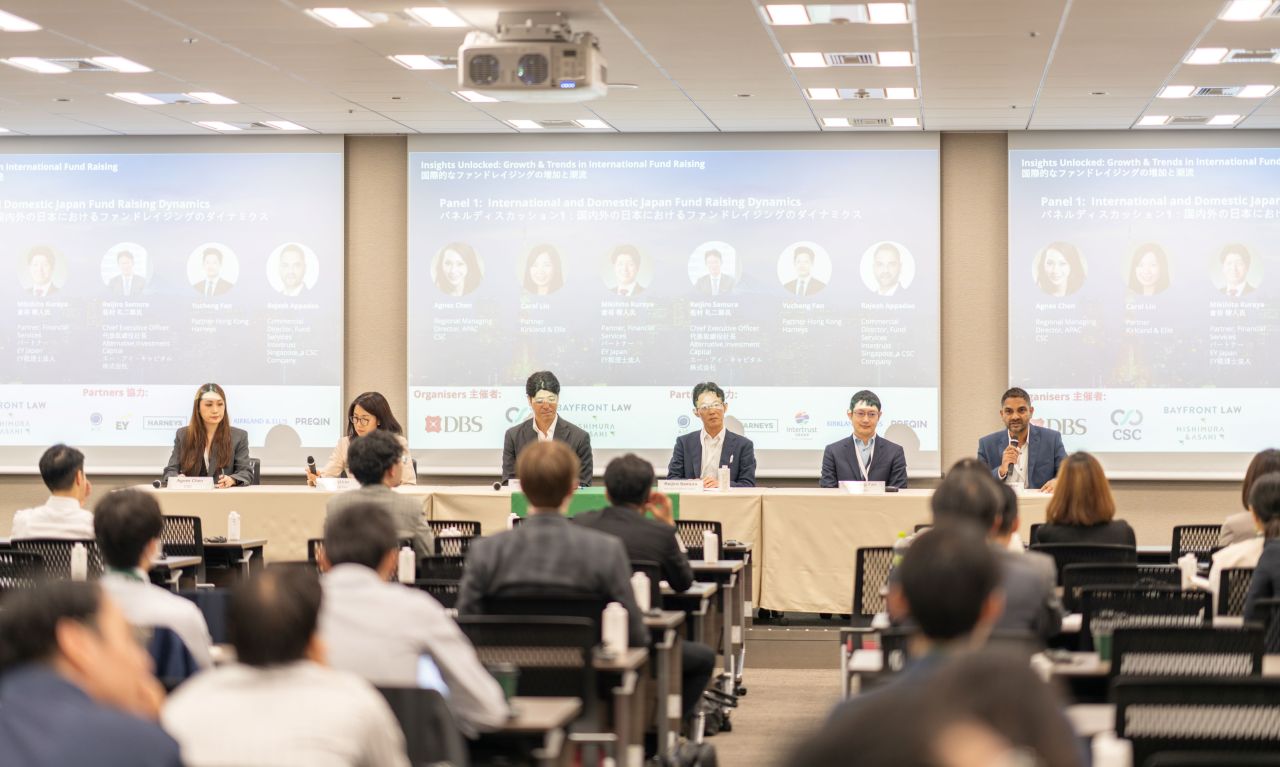
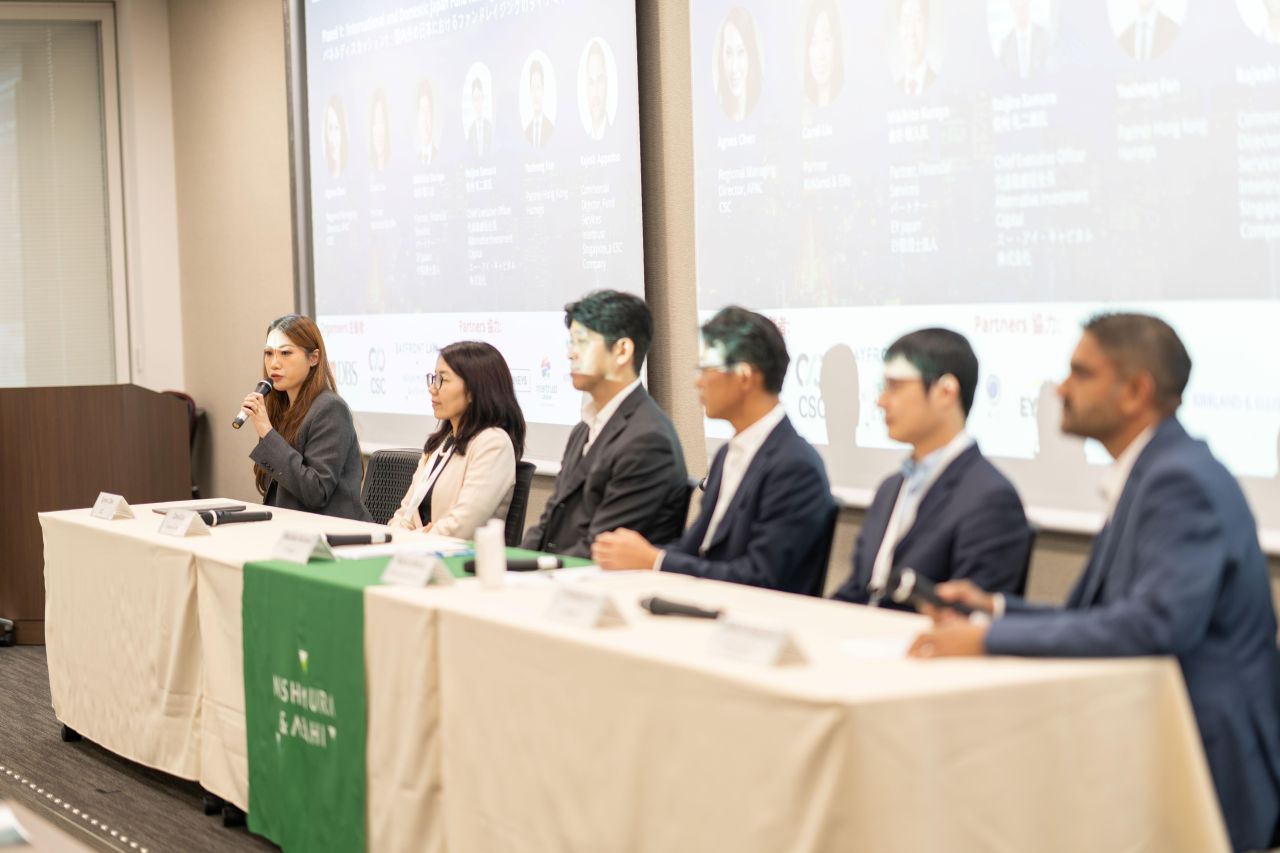
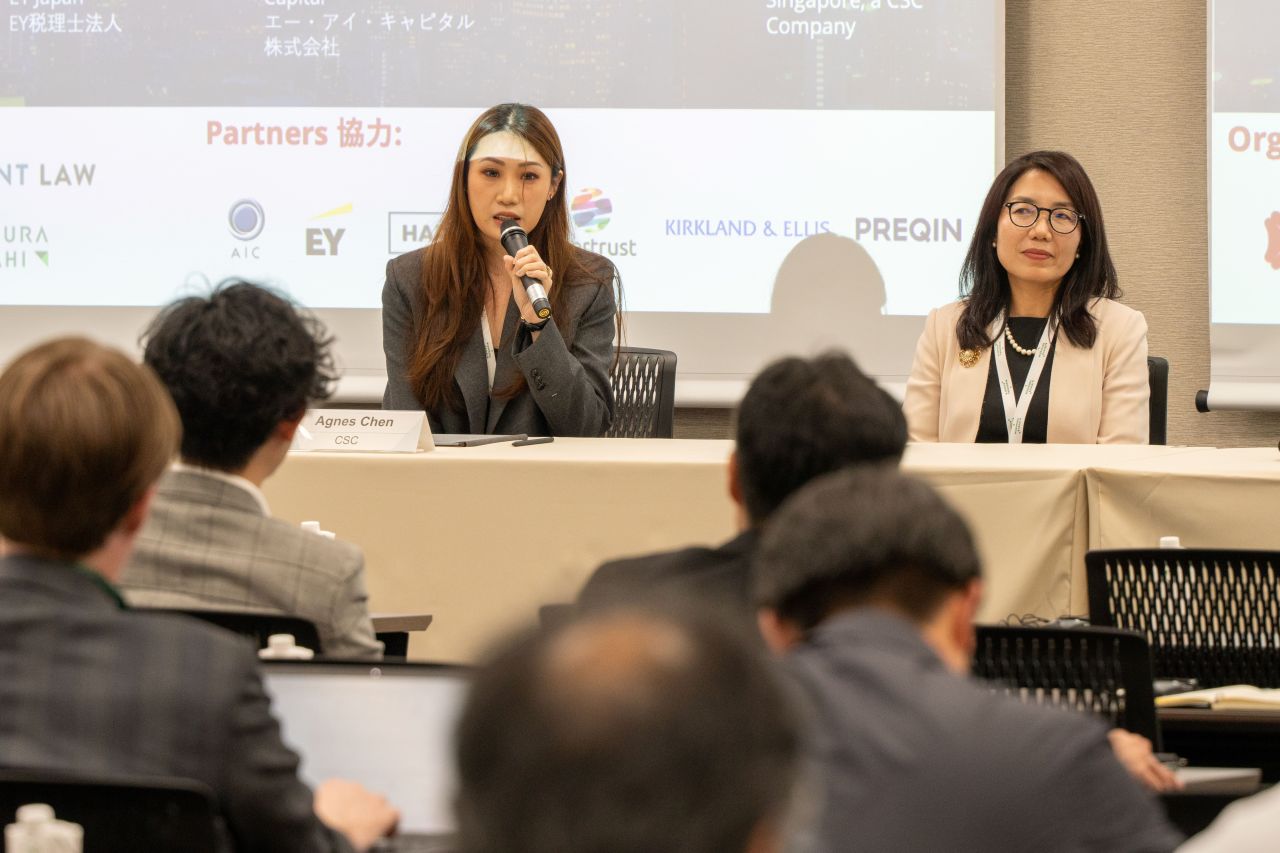
The “Growth & Trends in International Fund Raising” seminar hosted on October 4 by CSC in partnership with DBS Bank, Nishimura & Asahi, and Bayfront Law.
The seminar focused on macroeconomics, private equity and venture capital developments and provided exploration of the fundamentals of fund raising to share comprehensive insights into Japan’s financial landscape.
Joined a panel of experts to discuss private equity and venture capital trends in Japan as well as the broader APAC region. We look forward to continuing to work with our partners and help fund managers around the world access the growth potential in the region.
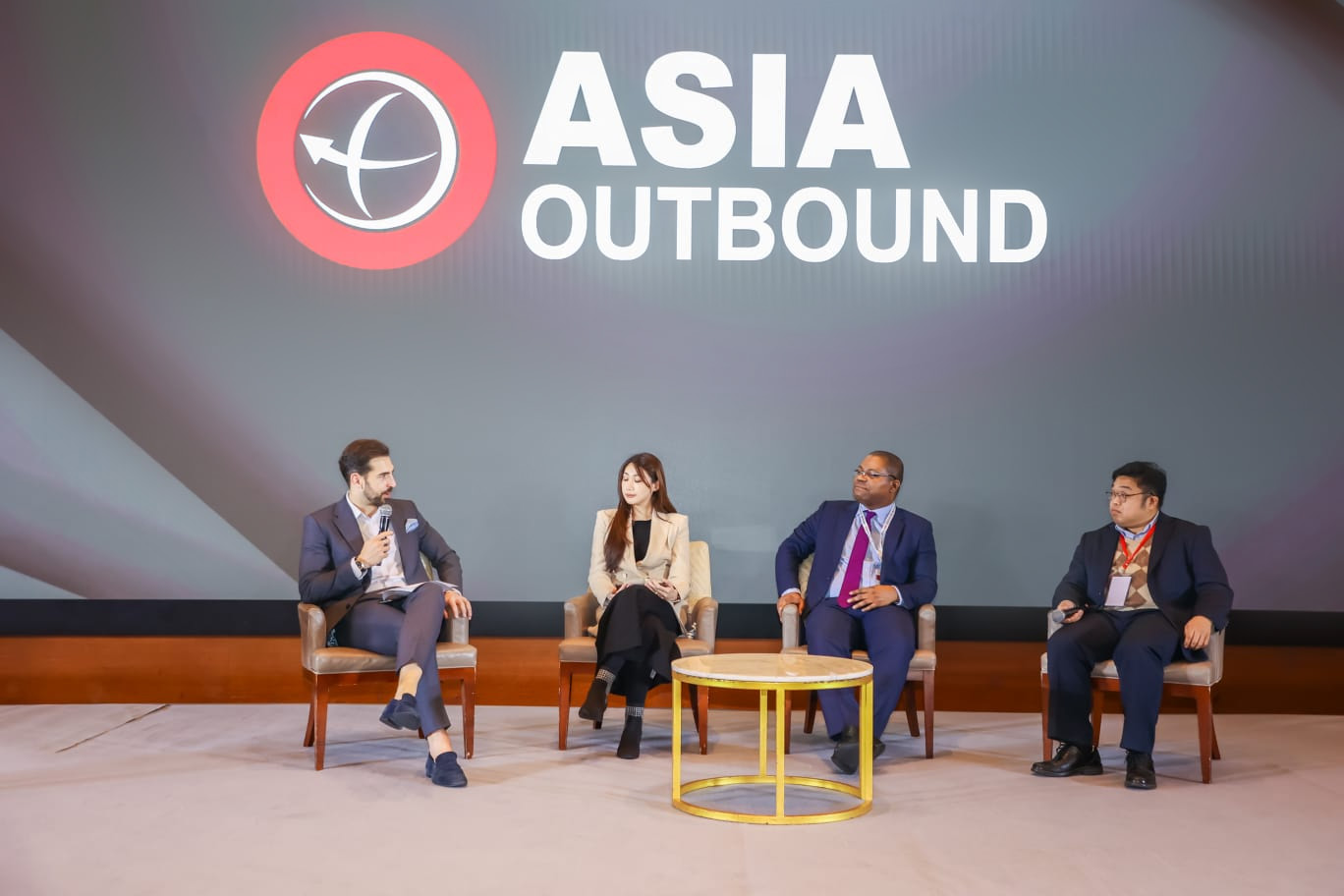
The Asia Outbound Summit in Shanghai was a great conference to connect, reflect, and discuss the industry with peers. Agnes Chen 陈美云 offered her expertise on the panel addressing Trends and Takeaways in APAC Offshore Fund Setup & Administration.
It was great to participate and share my experience and journey in leadership with our next generation and be part of Singapore Management University (SMU)’s Leadership seminar with CEOs.
Thank you Wee Liang Tan, Prof. for your kind invitation and the students at Singapore’s SMU Lee Kong Chian School of Business.
Great engaging session and all the best! It was great to be able to share and give back to the industry and community!
Pleased to be part of the esteemed panel speakers at the CSIS (Chartered Secretaries Institute of Singapore) 8th Corporate Service Provider (CSP) Conference 2023 held 11th July in Singapore.
The conference discussed emerging challenges in our everyday operations as Corporate Services Providers and the trends and changes in legislations. Thank you to ACRA – Accounting and Corporate Regulatory Authority , IMDA, Inland Revenue Authority of Singapore (IRAS) and Singapore Police Force for the informative trends and insights that allow us to better understand the developments and what Corporate Service Providers should take note to stand in the forefront to ensure we are ready for the industry developments ahead for the future but also areas to ensure we better protect our clients and partners with good governance.
Thank You for the kind invitation and it is my honour to be able to share our experiences and best practices knowledge to our fellow industry practitioners.
Has Singapore become a victim of its own success? And can Hong Kong recover its position?
Hong Kong (left) or Singapore (right)?
As the most prominent financial hubs in Asia, and increasingly in the world, Hong Kong and Singapore have been pitted against each other time after time. The competition between the two cities is infamous, but is it time to lay down the swords? Citywealth speaks to industry experts on how the cities can complement, rather than compete against, one another. We dive into the strengths and weaknesses of each city, as highlighted by those who deal with them firsthand, and uncover all the necessary considerations for UHNW individuals and their advisers when choosing which city is best suited to their unique circumstances.
Despite the rapid growth of Hong Kong and Singapore as dominant players in the race to become leading hubs for family offices, there are current concerns surrounding each city. Two key questions come to mind: Are people leaving Hong Kong, and why? Has Singapore become a victim of its own success as its cost-of-living rises?
Regarding Hong Kong, Partner at Zhong Lun Clifford Ng said: “There is empirical evidence that people have been leaving Hong Kong. If nothing else, the delay in reopening compared with other financial centres including Singapore was a major catalyst. However, the tide has probably changed, and I expect there will be net inflows to Hong Kong through the remainder of the year.”
Of Singapore, he added: “Singapore has been extremely successful in attracting people through their family office regime and because Singapore reopened much sooner than Hong Kong. That has reflected in much higher housing costs. For small cities like Singapore and Hong Kong, it doesn’t take a lot to move housing prices.”
Agnes Chen, Managing Director APAC for CSC Global Financial Markets, a trust company, commented on Hong Kong: “We believe that there are reports made of individuals and businesses relocating or making adjustments to their presence in Hong Kong. During the Covid situation people did this to be nearer to their direct families. Some of this may be influenced by factors such as policies. Decisions to move are often a mix of numerous factors but we have seen stability since the reopening of Hong Kong from Covid times to bring back more visitors and travelers.”
In response to the question on Singapore’s rising cost of living, Chen said: “Singapore is known in global indexes as one of the most expensive cities in the world and for its high cost of living compared to many other countries. The perception of affordability can vary depending on individual circumstances, perspectives, or lifestyles. While Singapore does have to a certain extent a relatively high cost of living, it also offers a high standard of living with excellent infrastructure, healthcare, safety, wellness and education.”
“Singapore’s strength is also her proactive and engaging policy makers and has implemented quick and immediate measures to mitigate challenges and ensure balance between economic growth and social wellbeing as needed. I would say the interpretation is subjective to the individual based on the balance preferred.”
‘Hong Kong is an integral part of China. Singapore is not.‘
Whilst they share the continent of Asia, the geographical placement of each city is a crucial consideration. Ng said: “The key difference between the two is that Hong Kong is an integral part of China and Singapore is not. For clients who want to have some money and infrastructure outside China, Singapore is the logical choice. For those who want some money and infrastructure inside China, Hong Kong is the place. Those based in Hong Kong do not need to give up their China status which is key to hold certain businesses in China. Many UHNW clients will see a need to be in both places, so I see them as complementary and not competitive.”
The Monetary Authority of Singapore is actively promoting Singapore as a hub for family offices
Chen weighed up the two cities in terms of their regulatory environments, and how their respective locations and resulting target markets overlap. She said: “One of Singapore’s strengths is its regulatory environment, which is known for being business-friendly and transparent. Their financial regulator, Monetary Authority of Singapore (MAS), has been actively promoting Singapore as a hub for family offices and has introduced various initiatives to attract wealth managers, such as the Variable Capital Company (VCC) framework. The VCC framework allows family offices to set up investment funds in Singapore. Hong Kong, on the other hand, has long been a gateway to China and is well-positioned to serve the country’s growing number of high-net-worth individuals. Hong Kong is also known for its deep and liquid capital markets, which provide a wide range of investment opportunities for family offices.”
“Both cites target different markets, with Singapore focusing on Southeast Asia and Hong Kong on Greater China. Singapore has a strong presence in Southeast Asia and has been attracting family offices from countries such as Indonesia, Malaysia, and Thailand and some from the greater China region in the looks of expansion. In contrast, Hong Kong is a financial hub in Greater China and has been attracting family offices from mainland China, and other parts of East Asia. The Hong Kong Government had recently rolled out policies on developing family office businesses in Hong Kong, many of the initiatives such as capital investment entrant scheme, tax concessions, developing Hong Kong into a philanthropic centre, expanding the expertise in family offices, and launching a new network of family office service providers may also strengthen the city’s positioning as a financial hub.”
Hong Kong has a vibrant capital market and Singapore a larger forex business
Kevin Lee, Suzanne Johnston, and Ross Davidson at Stephenson Harwood emphasised that the two cities play complementary roles, each offering unique benefits to families depending on their specific objectives. They said: “Singapore is better connected to the Southeast Asian market and India whilst Hong Kong offers proximity to the significant Chinese market with most of North Asia lying within a four-hour flight from Hong Kong. Private wealth management is growing in both markets with Hong Kong having a more vibrant capital market and Singapore having a larger forex business. Both markets have family office and immigration schemes to attract wealthy families.”
Tax benefits for family offices in Singapore
Stephenson Harwood continued: “Singapore has been at the forefront of the family office industry in recent years, offering two key incentive schemes – Sections 13O and 13U – that provide significant tax benefits for family offices in Singapore. Singapore therefore has early mover advantage in relation to its family office regime with its already well-established family office ecosystem. Hong Kong has recently introduced its own tax concessions for family-owned investment vehicles providing a similar tax regime to Singapore’s Sections 13O and 13U. While the Hong Kong regime is relatively new, it has already been met with enthusiasm.”
“In addition to the tax incentives, Singapore has a Global Investor Programme (GIP), which has been key in attracting family offices to Singapore. Principals can apply under the GIP for permanent residency provided they have a substantial business track record and at least S$200m in net investible AUM. Meanwhile, Hong Kong is planning to relaunch a modified version of its Capital Investment Entrant Scheme (CIES) as part of its efforts to attract more family offices and high-net-worth individuals to establish businesses and reside in Hong Kong. While real property would be excluded, investible assets under the CIES will potentially include innovation and technology sectors aside from financial assets. The CIES is expected to allow eligible applicants to obtain Hong Kong permanent residency status more easily and faster than under existing immigration schemes.”
Complementary? Or competition?
Stephenson Harwood concluded: “By understanding the strengths of each jurisdiction, families can identify the most suitable location for their specific needs and objectives. As ever, there is no one size fits all approach.”
Ng agrees, saying “the two jurisdictions are fundamentally different in key aspects, and they are more complementary than competitors” and Chen concluded: “Both cities have their unique strengths and advantages, and family offices may choose one over the other based on factors such as regulatory environment, investment opportunities, tax policies, and cultural affinity. Ultimately, it’s up to individual family offices to determine which city is the best fit for their long-term objectives for their family.”
So, has Singapore become a victim of its own success? The answer is yes and no; it has certainly benefited from Hong Kong lockdowns, but it remains fast and furious with competitiveness and has a very different culture to Hong Kong due to its geography. Hong Kong is already showing signs of recovery with the outflows of people starting to slow and will always feast on the enormous inflows from mainland China. So, as our advisors determine – are they actually more complementary than competitors? Different opportunities are solidifying in both jurisdictions making them more of an Asian superpower, not too dissimilar to the comparisons of London.
A family office is an organization created to manage the wealth and investments of a high net worth family or individual. It provides a range of services such as investment management, tax planning, philanthropy, and estate planning. Singapore is an attractive location to set up a family office due to its stable economy, favorable tax policies, and business-friendly environment.
The following is a step-by-step guide to setting up a family office in Singapore:
Step 1 : Define your objectives
Before setting up a family office, it is important to determine the objectives of the office. This includes identifying the family’s current and future financial needs, goals, and priorities. This will help in determining the type of services required from the family office.
Step 2: Choose the right structure
The next step is to choose the right structure for the family office. The most common structures are a single-family office, which is created for a single family, or a multi-family office, which serves multiple families. Other options include a private trust company or a corporate entity. Each structure has its own advantages and disadvantages, so it is important to choose the one that best fits the family’s objectives.
Step 3: Determine the regulatory requirements
Family offices in Singapore are regulated by the Monetary Authority of Singapore (MAS). The regulatory requirements will vary depending on the structure of the family office. For example, a single-family office may not be required to be licensed by the MAS, while a multi-family office will require a capital market services license. It is important to seek professional advice to ensure compliance with the regulatory requirements.
Step 4: Choose the right service providers
Once the structure has been determined and regulatory requirements have been met, the family office will require the services of various professionals such as lawyers, administrators, accountants, and investment managers. It is important to choose service providers who are experienced in working with family offices and have a good understanding of the family’s objectives.
Step 5: Implement the family office
Once all the steps above have been completed, the family office can be implemented. This include establishing policies and procedures, hiring staff, and setting up systems for investment management, accounting, and reporting. It is important to ensure that the family office is structured in a way that is flexible and can adapt to changing circumstances.
In conclusion, setting up a family office in Singapore can be a complex process, but with proper planning and guidance, it can be accomplished efficiently. It is important to define the family’s objectives, choose the right structure, determine the regulatory requirements, choose the right service providers, and implement the family office. Seeking professional advice is essential to ensure compliance with regulatory requirements and the successful implementation of the family office.
Founded in 1899, CSC Global Financial Markets provides corporate trust and agency, special purpose vehicles management, fund administration and global expansion services to 10,000 law firms, 3,000 financial institutions and 90 per cent of the Fortune 500 companies worldwide.
The Asia–Pacific (APAC) division is only eight years old, but Managing Director Agnes Chen is at the helm of its expansion into the region. “CSC has a great heritage being more than a century old,” Agnes says. “The APAC business has been in the space for about eight years now, so it’s relatively young compared to the group itself. It is becoming a more important region for the company, but also across the world APAC is becoming more focused in terms of growth model and opportunities.”
CSC is focusing on dynamic growth both globally and in the APAC region in the next five years. “We’re looking at an extension of our suite of services globally,” Agnes says. “There will be new legislation that provides more innovative structure and opportunities. We’re tapping into this to be agile and dynamic in terms of what we do to fit into the future of APAC.”
The company plans to invest in three key areas to drive its expansion. “One of the main areas is talent,” she says. “People are the key resource in a service business, so a lot of our focus is on the expertise of our people. We’ll also heavily invest in technology in the next few years and tap into our group’s strength in this area. There’s a lot of foresight in our management to pre-adopt technology and roll it out. APAC is very paper-based, but CSC moved forward in that respect even before COVID-19 hit. We’ll also continue to focus on client servicing and the value we provide to our clients – that’s our key strength.”
The global CSC group’s wealth of expertise in corporate services will serve the APAC division well. “We’ll tap into the heritage of our company and its strength in terms of business culture to stay a step ahead of our competitors,” she says. “We’ll bring our expertise to our clients and make sure that their operations are as efficient as possible and compliant in the market. We’ll look to close any gaps that we can to provide our clients with a holistic structure and support.”
Delivering expertise
With numerous international CSC clients having their sights set on APAC, Agnes has her work cut out for her. “We have multinational companies looking at Asia in terms of expansion and large investment managers looking to invest in APAC for their clients,” she says. “There are also companies looking to tap into fundings and investments.”
People are the key resource in a service business, so a lot of our focus is on the expertise of our people.
CSC’s global team of corporate and fund services experts, along with the expertise of legal and advisory client counsels, allow the company to cover every aspect of a given transaction.
“If a multinational corporation would like to set up its new headquarters in Singapore, there are many legal perspectives to consider,” Agnes says. “What’s the best structure in terms of making it work and being optimised? At the same time, they may be concerned about how to structure in terms of tax implications. They want to be 100 per cent sure that they’re fulfilling any requirements. We can help them with all these aspects.
“A fund manager with an investment fund may come to us to incorporate the structure, but they may also require the fund documents to be drafted. We then bring in our expert partners to draft these documents. We can provide different types of expertise as the client requires.”
“
We have multinational companies looking at Asia in terms of expansion and large investment managers looking to invest in APAC for their clients.
”
Agnes believes agility will be the key to CSC APAC’s success in the next five years and into the future. “Because a lot of what we do is dependent on government statutory requirements, being agile means looking at everything that needs to happen for the client and thinking quickly on our feet to make it happen while also making sure the client is being compliant,” she says.
Born and bred in Singapore, Agnes knows the market well and is up to the task of bringing CSC APAC to the next level. “I’m a person who fits into the plan very quickly and I adapt really quickly as well,” she says. “I go with the flow and I think it’s important to keep an open mind. The pandemic has taught us a lot about flexibility in the last two-and-a-half years. As we open up to the world right now, we need to take what we have learnt and rethink our plans.”
FAST FACTS
CSC is privately held.
The company has more than 50 international office locations, including in Delaware, New York, London, Hong Kong and Singapore.
CSC services 120 jurisdictions worldwide.
The company has 180,000 corporate customers, including 90 per cent of the Fortune 500 companies.
DealStreetAsia to launch the first few closed door exclusive luncheon for the Family Office and Asset Management space in #singapore.
Our sincere appreciation to the dedicated Dealstreet Team and Raffles Hotels & Resorts for the heavy lifting from the invitations to the planning, venue and hosting of the event etc.
It’s been awhile since there was so much catch-ups and interaction of Professionals in one room, we hope it was a worthy session for all attendees.
Link below to dealstreetasia coverage of the event